
Mbappe Dominates Individually at Real Madrid but Pulls the Whole Structure Apart
Authored by 2d-sport.com, 15/04/2026
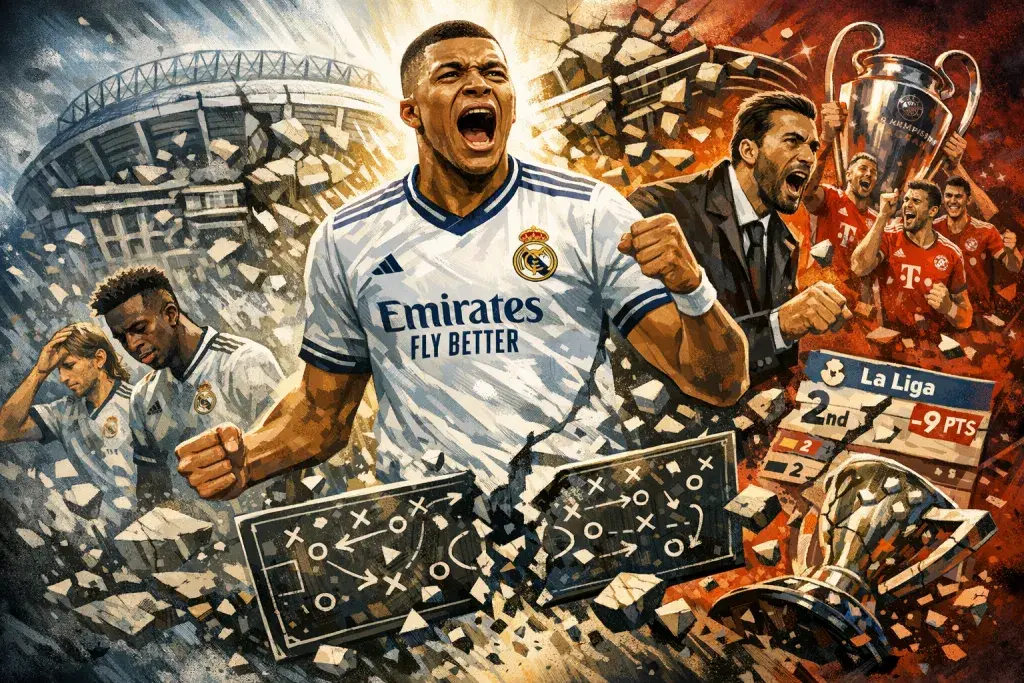
Eighty-three goals in 97 appearances is the kind of output that settles most arguments before they begin. By the most visible measure of a forward's value, Kylian Mbappe's move to Real Madrid on a free transfer in 2024 has delivered exactly what was promised. And yet, two seasons into the arrangement, the club that built a dynasty on collective excellence finds itself nine points adrift in La Liga with seven fixtures remaining, and facing elimination from the Champions League after losing the home leg of the last eight to Bayern Munich. Personal brilliance and institutional decline are, it turns out, entirely compatible.
The Numbers That Flatter and the Numbers That Damn
Mbappe's 39 goals across all competitions this campaign place him second in Europe's top five divisions, behind only Harry Kane at Bayern Munich. In the opening months of the season he was close to irresistible — 27 goals before the winter break, including four in a single Champions League fixture against Olympiacos, and the decisive effort in an October Clásico victory that put Real five points clear. Comparisons to Cristiano Ronaldo arrived on schedule, and Mbappe, to his credit, deflected them with the right words: "I want to follow my own path. Being mentioned alongside Cristiano is already an honour, but I just want to make my own way, help the team, and win as many titles as possible."
The second half of the season has told a different story. Since mid-February, Mbappe has converted just one goal in seven appearances. His shot conversion rate, which sat at 25 percent for the 2025-26 campaign, has collapsed to four percent. In a 1-1 draw with Girona at the Bernabéu, he produced an expected goals on target figure of 0.14, surrendered possession 20 times, and won fewer than a quarter of his ground duels. These are not the statistics of a player in a temporary dip; they are the profile of someone whose influence on the broader system has become structurally corrosive.
What Happens When Mbappe Leaves the Room
The clearest evidence of Mbappe's systemic cost came not from his worst performances but from his absences. Between late February and late March, while he sat out with a knee complaint, Real won six of seven fixtures. They eliminated Benfica and Manchester City from the Champions League, home and away. Vinícius Júnior, operating with genuine freedom in a more compact 4-4-2 shape, recaptured the form that had made him a Ballon d'Or contender. Federico Valverde ran at defences. Aurélien Tchouaméni controlled the midfield. No single channel was overloaded. The side functioned as an interconnected whole rather than as a delivery mechanism for one man's finishing.
When Mbappe returned, new head coach Álvaro Arbeloa reverted to the same feed-the-forward structure his predecessor had relied upon, and the results regressed accordingly. One point from two fixtures. No viable alternative when opposing defences shut off the central supply line. It is a pattern that stretches back to Mbappe's first season in Madrid, when his 44 goals — 31 of them in the domestic league — contributed to a final tally nine goals lower than Real had managed the previous campaign. The club was eliminated from the Champions League quarter-finals in a 5-1 aggregate defeat to Arsenal, with Mbappe peripheral throughout.
A Structural Ego, Not Just a Difficult Personality
The tactical problem has a psychological dimension that Mbappe himself has partially acknowledged. During the March international break, speaking on The Bridge podcast, he said: "I'm a player who defends a little less than others, and sometimes that can be a problem. It's true that I do it less, but I notice that when I do, it really impacts the team." The observation is accurate. The conclusion he draws from it — that selective effort is sufficient — is the problem.
Former PSG head coach Luis Enrique attempted to address this directly, invoking Michael Jordan's defensive intensity as a model of how elite performers set standards for those around them. The lesson appears not to have landed. Mbappe's final season in Paris ended with the club winning nothing of significance under his leadership. His successor as the focal point of the PSG attack, Ousmane Dembélou, transformed his output when handed genuine responsibility and collective obligation — pressing relentlessly, finishing the 2024-25 season with a Ballon d'Or. Mbappe, meanwhile, finished seventh in the same vote, despite his goal return being objectively elite.
The pattern is consistent enough to be structural rather than circumstantial. Real Madrid, like PSG before them, have organised their entire attacking identity around the assumption that Mbappe will produce. When he does, they win. When he doesn't — or when opponents simply neutralise him — the scaffolding collapses. There is no Plan B because the plan was always Mbappe. That is not a squad built for sustained dominance. It is a squad built around a wager.
The Wider Question Real Madrid Must Now Answer
Barcelona's nine-point lead represents more than a seasonal advantage. With Mbappe approaching 28 and showing signs of inconsistency under pressure, Madrid face a genuine strategic decision: continue building around an individual whose ego demands structural accommodation, or reconstruct around the collective model that delivered their most recent era of European dominance. The evidence from this season suggests those two directions are mutually exclusive.
Mbappe's legacy at the club will ultimately be defined not by the goals he scores in routine fixtures but by what happens in the moments that matter most — the eliminatories, the Clásicos, the nights when the margin for error disappears. By that measure, the record so far is poor. Magnificent in aggregate. Insufficient when it counts. Real Madrid built their identity on winning the hardest things. Mbappe, for all his individual brilliance, has not yet helped them do that. The question of whether he ever will is the one that will define both his career and the club's next chapter.